Reading is to the mind what exercise is to the body Joseph Addison, English Essayist, Poet, Dramatist and Statesman. 1672 - 1719


'Clarice's Book Page' is the 'reading room' of the 'Elizannie' page at: http://www.rephidimstreet.blogspot.com/

Tuesday, 11 October 2011

Poem by Bertolt Brecht


[Dedicated to all those protesting against all wars everywhere, especially all those who were in Trafalgar Square on Saturday and all the other linked demonstrations all over the world on Saturday. May Peace Prevail. Clarice]


General, your tank is a powerful vehicle.
It smashes down forests and crushes a hundred men.
But it has one defect:
It needs a driver.

General, your bomber is powerful.
It flies faster than a storm and carries more than an elephant.
But it has one defect:
It needs a mechanic.

General, man is very useful.
He can fly and he can kill.
But he has one defect:
He can think.


Bertolt Brecht

Photograph of Brecht courtesy of Wikipedia.org

Sunday, 9 October 2011

Prayer Before Birth by Louis Macneice


The photograph shows a memorial to the fallen in Afghanistan and Iraq at the Antiwar Mass Assembly in Trafalgar Square yesterday. It features the following very appropriate poem by Louis Macneice:

Prayer Before Birth
I am not yet born; O hear me.
Let not the bloodsucking bat or the rat or the stoat or the
club-footed ghoul come near me.

I am not yet born, console me.
I fear that the human race may with tall walls wall me,
with strong drugs dope me, with wise lies lure me,
on black racks rack me, in blood-baths roll me.

I am not yet born; provide me
With water to dandle me, grass to grow for me, trees to talk
to me, sky to sing to me, birds and a white light
in the back of my mind to guide me.

I am not yet born; forgive me
For the sins that in me the world shall commit, my words
when they speak me, my thoughts when they think me,
my treason engendered by traitors beyond me,
my life when they murder by means of my
hands, my death when they live me.

I am not yet born; rehearse me
In the parts I must play and the cues I must take when
old men lecture me, bureaucrats hector me, mountains
frown at me, lovers laugh at me, the white
waves call me to folly and the desert calls
me to doom and the beggar refuses
my gift and my children curse me.

I am not yet born; O hear me,
Let not the man who is beast or who thinks he is God
come near me.

I am not yet born; O fill me
With strength against those who would freeze my
humanity, would dragoon me into a lethal automaton,
would make me a cog in a machine, a thing with
one face, a thing, and against all those
who would dissipate my entirety, would
blow me like thistledown hither and
thither or hither and thither
like water held in the
hands would spill me.

Let them not make me a stone and let them not spill me.
Otherwise kill me.

Louis Macneice


The poem is a plea from the future, from the child[ren]/generations yet unborn that we - the present generation - may provide them with a world free from all the problems that Man has created so far:
'Tall walls to wall me' - prisons
'Strong drugs dope me' - drugs that tranquilise and lull
'Wise words lure me' - lying politicians
'Black racks rack me' & 'in blood-baths roll me' - torture in the names of 'freedom' & 'truth'

The future children ask the present generation to provide not material things but not to interfere with the natural gifts:
'water to dandle me'
'grass to grow for me'
'trees to talk to me'
'sky to sing to me'
'birds'
and lastly
'a white light in the back of my mind to guide me' - a faith or morality to live by

The future children ask that they may be forgiven in advance:
'For the sins that in me the world shall commit'
'my words when they speak me'
'my thoughts when they think me'
'my treason engendered by traitors beyond me'
'my life when they murder by means of my
hands'
'my death when they live me'
But the use of 'my' as the first word and 'the world/they' as the perpetrator shows the disgust that such things are done by 'the world/they' in the name of the innocent/yet to be born. Of course 'the world' represents the world leaders who always act in the name of 'their people', however much those people protest that it is Not in their Name

The future children ask
'rehearse me In the parts I must play'
'the cues I must take when:
old men lecture me
bureaucrats hector me
mountains frown at me
lovers laugh at me
the white waves call me to folly
the desert calls me to doom
the beggar refuses my gift
my children curse me'

- how to live in world where it is difficult to:
introduce new ideals
live within the often crazy laws
preserve the ecology
maintain dignity
remember the sea is stronger than man
remember the deserts show nature's power
remember charity is not always the answer
the future children's children will be as hard on their forebears as the future children will be on us.


The future children ask that we, the present hear them
'Let not the man who is beast or who thinks he is God
come near me' - that those whose who think they have the answers but whose answers are flawed will keep away.

The future children ask that they will be given:
'strength against those:
who would freeze my humanity
would dragoon me into a lethal automaton
would make me a cog in a machine
a thing with one face, a thing, and against all those who would dissipate my entirety,
would blow me like thistledown hither and thither or hither and thither
like water held in the hands would spill me'

- In other words those who would enlist humanity into soldiers, armies, fighting machines or enact violence 'in their name'.

'Let them not make me a stone and let them not spill me.
Otherwise kill me.'
- If the future children become 'automaton' fighting machines/killing machines, they feel their lives will not be worth living.

********

This is only my 'interpretation'. I would welcome different views and discussions.

Full lists of all those who died can be found here: http://www.bbc.co.uk/news/uk-10629358
May they sleep gently


For more photos taken by us at the Antiwar Mass Assembly go to http://www.flickr.com/photos/t​heotherbailey/sets/72157627846​775502/

Wednesday, 5 October 2011

The Times Aren't Always A-Changing


The blog title is obviously - to those who know their Bob Dylan - a bad misquote of his famous song. So why would I misquote one of musical heroes, who incidentally is 'up for' a Noble Prize for Literature tomorrow?

Its been one of those afternoons when I have been conducting an interesting internet discussion which was both political and literary with an internet buddy, whilst at the same time writing an Elizannie blog and also chatting to family on facebook and listening to a new CD. Which probably means that as usual I wasn't really doing any of those things very well.

My internet discussion was around the fact that history repeats itself if we don't allow ourselves to learn the lessons that it can teach us. In this instance my buddy and I were using the instance that 19thC literature can show us what life was like before the Welfare State in the UK as in Gissing's The Nether World [for the UK] or any of Theodore Dreiser's books for pre 'safety net' facilities [for the US] The discussion also included references to two hymns, one a paen to Conservatism and another to Socialism [obviously the better one] and if you wish to sample these go to the Elizannie blog here

As always when discussing literature, which then leads to history, then on to politics, music crops up and as I was listening to the new Ry Cooder album, Pull Up Some Dust and Sit Down I began to feel more than a bit sad and angry. I realised that the artiste was basically saying the same thing as my 'discussion buddy' and I, although even more harshly. To quote from this BBC review of the album:

When Ry Cooder recorded his first two albums, collections of songs by the likes of Lead Belly and Woody Guthrie that evoked the desperate times of the Great Depression, he could scarcely have imagined that 40 years later he’d be singing of the same old problems, but relating them to modern times.


As I have said to others, if you only buy/download one CD this year, make it this one. And learn and share with others the lessons Ry Cooder has written and sings.

Photo of the CD, courtesy of amazon.co.uk

Monday, 12 September 2011

The Immortal Life Of Henrietta Lacks


Sometimes a book appears that although one knows its official genre, that 'categorisation' refuses to sit well in one's brain!

A friend rang a few days ago to talk about a book she had just read. We have similar tastes so often recommend books to each other! As she explained about this book - a true story - it sounded so fascinating that it had to be immediately ordered from you-know-where. And when it arrived it proved to be one of those books that once started, refused to be put down.

The author says in the first sentence: This is a work of nonfiction . It is [in my opinion!] a biography, a science journal, a history book, a sociological study of America in the 1950s and race relations, a discussion of patient/doctor relationships that is relevant to the present day, a look at family relationships and more. [Please don't panic at the word 'science'. I did but understood those bits of the book perfectly thanks to the excellent writing]

Henrietta Lacks was an American woman who sadly died in 1951. Scientists took cells from the diseased parts of her body, 'grew' these cells and used them to experiment for other medical discoveries. Boring? Sounds it, to be honest. But these cells were the first that scientists had ever been able to 'grow' in a laboratory and from these cells - named 'HeLa'- all sorts of discoveries were and are still being made including the efficacy of the Salk polio vaccine, AIDS vaccines, blood pressure remedies - oh the list goes on and on.

However, Henrietta's family were never informed about the 'immortality' of her cells and in fact lived in very poor conditions. When many years after her death they did find out snippets of information [or misinformation] about the use of her body samples it affected them in differing ways. The author writes with such compassion about the family members that the reader feels at the end of the book sorry to leave the family behind.

If you get a chance to read this book I really hope you take it! The author, Rebecca Skloot, established the Henrietta Lacks Foundation before the book was published and some of the proceeds of the book are donated to that organisation.

Photograph of the paperback edition of the book courtesy of www.amazon.co.uk

Wednesday, 25 May 2011

Bob Dylan: Love Minus Zero/No Limit


Yesterday Elizannie published a blog to wish Bob Dylan a happy 70th birthday. Amongst all his other skills, Dylan is a master at using words and his love of language shows in his songs and speech. So today I thought I would illustrate this by showing one of his early songs, written c1964 and recorded on his Bringing It All Back Home* Album in 1965: Love Minus Zero/No Limit

*{The album cover for Bringing It All Back Home is shown above. A proud possession as it is the first Dylan Album {LP} that I ever bought. It cost 30/-
[£1.50p] and I was still at school so to raise the funds I sold all my Cliff Richard LPs to Marion Richards. My friend Shirl still thinks I am mad.}

Whilst LMZ/NL is a love song, written to his forthcoming wife Sara, it is for his fans an early 'showpiece' for Dylan's mastery of musical composition, his power with words and his influences by allusions to works including those by Blake, Edgar Allan Poe and also the Old Testament. It has been recorded by many other artistes including those as diverse as the Walker Brothers and Rod Stewart! Dylan has performed it on many tours over the years.


This is one of my favourite Dylan songs, but then I do have rather a lot of favourites...


Love Minus Zero/No Limit
My love she speaks like silence,
Without ideals or violence,
She doesn't have to say she's faithful,
Yet she's true, like ice, like fire.
People carry roses,
Make promises by the hours,
My love she laughs like the flowers,
Valentines can't buy her.

In the dime stores and bus stations,
People talk of situations,
Read books, repeat quotations,
Draw conclusions on the wall.
Some speak of the future,
My love she speaks softly,
She knows there's no success like failure
And that failure's no success at all.

The cloak and dagger dangles,
Madams light the candles.
In ceremonies of the horsemen,
Even the pawn must hold a grudge.
Statues made of match sticks,
Crumble into one another,
My love winks, she does not bother,
She knows too much to argue or to judge.

The bridge at midnight trembles,
The country doctor rambles,
Bankers' nieces seek perfection,
Expecting all the gifts that wise men bring.
The wind howls like a hammer,
The night blows cold and rainy,
My love she's like some raven
At my window with a broken wing.

Slightly miffed!


Usually I write my blogs for my own satisfaction and it is a bonus if anyone else reads or comments on them. Well that is the official line, but I have to admit I do look at the stats every now and again.

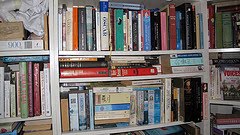
But it was rather galling to find that the set of photos that Other Half had taken of my study [one shown above] has had more views than most of mine or my twin sister Elizannie's blogs!:

http://www.flickr.com/photos/theotherbailey/sets/72157626758313712/

And yes, a copy of Blogging for Dummies can be seen on one of the shelves....

Wednesday, 18 May 2011

Someone at a Distance / Persephone Books


Just as in the years since 1973 when Virago Books first brought a different kind of [feminist] publishing to our attention and introduced many of us to new and previously 'forgotten' authors, Persephone Books have been doing a similar thing for a number of years. This extract from the 'mission statement' on their website explains the sort of authors Persephone publish:


Persephone Books reprints neglected classics by C20th (mostly women) writers..........


Just as I know when picking up a Virago book I am in for a good read, the distinctive Persphone book covers offer the same 'temptation'! So when I recently bought Someone at a Distance by Dorothy Whipple I settled down for a 'good read' and I wasn't disappointed!

I suppose that because I also taught Social History as well as English Literature this novel is a real 'double whammy' for me! It is a snapshot of England in the years just after the second world war, an England that has faded away and probably will not be recognised by anyone under thirty five! An England that had definite divisions between those that had 'daily women' and those who were the 'daily women'. It looks at the social mores and how society looked at divorces and the divorced and how women regarded their place and positions in society.

In the preface to the book, the novelist Nina Bawden describes it as a

a fairly ordinary tale about the destruction of a happy marriage

does the writing an enormous injustice if taken out of context. Bawden goes on to add
it makes compulsive reading

with which I certainly agree! Elsewhere in the preface Whipple is compared to Mrs Gaskell and to me the minutae of the North family life as written by Whipple is as fascinating as that of the Cranford villagers as written by Gaskell!

Apparently, although Dorothy Whipple had been a successful novelist, this was her last novel and her least successful - probably because post war Britain was on the cusp of the big changes that were to come and thus the book was notthen considered modern enough. But perhaps to us sixty years later this novel moves into a different genre, maybe into the 'historical novel' mode? I loved it and have already looked into finding more novels by Dorothy Whipple, to add to my list of loved authors of this time and earlier: Mollie Panter-Downes; Marghanita Laski; Elizabeth Taylor; Winifred Holtby and more. Thank goodness for Virago and Persephone Books!


Picture of the Persephone edition courtesy of amazon.co.uk. The book can also be purchased directly from the Persephone website.