Reading is to the mind what exercise is to the body Joseph Addison, English Essayist, Poet, Dramatist and Statesman. 1672 - 1719


'Clarice's Book Page' is the 'reading room' of the 'Elizannie' page at: http://www.rephidimstreet.blogspot.com/

Wednesday, 25 May 2011

Bob Dylan: Love Minus Zero/No Limit


Yesterday Elizannie published a blog to wish Bob Dylan a happy 70th birthday. Amongst all his other skills, Dylan is a master at using words and his love of language shows in his songs and speech. So today I thought I would illustrate this by showing one of his early songs, written c1964 and recorded on his Bringing It All Back Home* Album in 1965: Love Minus Zero/No Limit

*{The album cover for Bringing It All Back Home is shown above. A proud possession as it is the first Dylan Album {LP} that I ever bought. It cost 30/-
[£1.50p] and I was still at school so to raise the funds I sold all my Cliff Richard LPs to Marion Richards. My friend Shirl still thinks I am mad.}

Whilst LMZ/NL is a love song, written to his forthcoming wife Sara, it is for his fans an early 'showpiece' for Dylan's mastery of musical composition, his power with words and his influences by allusions to works including those by Blake, Edgar Allan Poe and also the Old Testament. It has been recorded by many other artistes including those as diverse as the Walker Brothers and Rod Stewart! Dylan has performed it on many tours over the years.


This is one of my favourite Dylan songs, but then I do have rather a lot of favourites...


Love Minus Zero/No Limit
My love she speaks like silence,
Without ideals or violence,
She doesn't have to say she's faithful,
Yet she's true, like ice, like fire.
People carry roses,
Make promises by the hours,
My love she laughs like the flowers,
Valentines can't buy her.

In the dime stores and bus stations,
People talk of situations,
Read books, repeat quotations,
Draw conclusions on the wall.
Some speak of the future,
My love she speaks softly,
She knows there's no success like failure
And that failure's no success at all.

The cloak and dagger dangles,
Madams light the candles.
In ceremonies of the horsemen,
Even the pawn must hold a grudge.
Statues made of match sticks,
Crumble into one another,
My love winks, she does not bother,
She knows too much to argue or to judge.

The bridge at midnight trembles,
The country doctor rambles,
Bankers' nieces seek perfection,
Expecting all the gifts that wise men bring.
The wind howls like a hammer,
The night blows cold and rainy,
My love she's like some raven
At my window with a broken wing.

Slightly miffed!


Usually I write my blogs for my own satisfaction and it is a bonus if anyone else reads or comments on them. Well that is the official line, but I have to admit I do look at the stats every now and again.

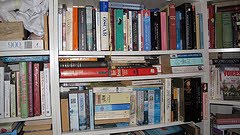
But it was rather galling to find that the set of photos that Other Half had taken of my study [one shown above] has had more views than most of mine or my twin sister Elizannie's blogs!:

http://www.flickr.com/photos/theotherbailey/sets/72157626758313712/

And yes, a copy of Blogging for Dummies can be seen on one of the shelves....

Wednesday, 18 May 2011

Someone at a Distance / Persephone Books


Just as in the years since 1973 when Virago Books first brought a different kind of [feminist] publishing to our attention and introduced many of us to new and previously 'forgotten' authors, Persephone Books have been doing a similar thing for a number of years. This extract from the 'mission statement' on their website explains the sort of authors Persephone publish:


Persephone Books reprints neglected classics by C20th (mostly women) writers..........


Just as I know when picking up a Virago book I am in for a good read, the distinctive Persphone book covers offer the same 'temptation'! So when I recently bought Someone at a Distance by Dorothy Whipple I settled down for a 'good read' and I wasn't disappointed!

I suppose that because I also taught Social History as well as English Literature this novel is a real 'double whammy' for me! It is a snapshot of England in the years just after the second world war, an England that has faded away and probably will not be recognised by anyone under thirty five! An England that had definite divisions between those that had 'daily women' and those who were the 'daily women'. It looks at the social mores and how society looked at divorces and the divorced and how women regarded their place and positions in society.

In the preface to the book, the novelist Nina Bawden describes it as a

a fairly ordinary tale about the destruction of a happy marriage

does the writing an enormous injustice if taken out of context. Bawden goes on to add
it makes compulsive reading

with which I certainly agree! Elsewhere in the preface Whipple is compared to Mrs Gaskell and to me the minutae of the North family life as written by Whipple is as fascinating as that of the Cranford villagers as written by Gaskell!

Apparently, although Dorothy Whipple had been a successful novelist, this was her last novel and her least successful - probably because post war Britain was on the cusp of the big changes that were to come and thus the book was notthen considered modern enough. But perhaps to us sixty years later this novel moves into a different genre, maybe into the 'historical novel' mode? I loved it and have already looked into finding more novels by Dorothy Whipple, to add to my list of loved authors of this time and earlier: Mollie Panter-Downes; Marghanita Laski; Elizabeth Taylor; Winifred Holtby and more. Thank goodness for Virago and Persephone Books!


Picture of the Persephone edition courtesy of amazon.co.uk. The book can also be purchased directly from the Persephone website.

Wednesday, 23 March 2011

Bread and Roses


18.12.2011 Just found another link for Joan Baez and Mimi Farina singing the inspirational song:


Original Blog:


Whilst 'blog surfing' in my Elizannie hat, I came across a quote from Bread and Roses on Jon Rogers excellent political blog: http://jonrogers1963.blogspot.com/

This is the quote, [on a MayDay card which I have reproduced on the right]:

Our lives shall not be sweated from birth until life closes;
Hearts starve as well as bodies;
Give us bread, but give us roses.


This was so redolent of so many memories and ideas to me that I thought it might be interesting to explore it further on this page!

The poem Bread and Roses was originally written by James Oppenheim (1882-1932), an American poet and writer. He was the founder and editor of The Seven Arts, an early 20thC literary magazine. He wrote about labour struggles troubles [including suffragist themes] in his 1911 fiction book The Nine-Tenths (1911) and in the poem Bread and Roses was also written in 1911 but I suppose came to prominience as a motif for the 1912 textile workers' strike in Lawrence, Massachusetts and as such is associated with the womens' movement because those involved with the strike were mainly women.

The 1912 Lawrence Textile Strike was Union led [by the Industrial Workers of the World] and the immigrant workers were mostly women. One employer lowered wages when the working week was shortened by law,and the industrial action eventually spread to twenty thousand workers at nearly every mill within a week. The strike, despite preidctions of other American trade unions that the workforce of a true downtrodden minority - that of ethnically diverse and mostly women workers - could not be organized, was successful. Sadly over time the union collapsed and workers rights once more were eroded.

The 'Bread and Roses' in the refrain stand for the way that workers lives are made up of more than just the struggle for work and the struggle for beauty has to take place too - other wise work has no inner meaning. To progress is not just for material gain but for emotional and spiritual beauty in our lives!

The term 'Bread and Roses' has since been associated with political strife and was the title of the 2000 Ken Loach film about the right to form a union of Mexican labourers in Los Angeles.

Here is the poem:

As we come marching, marching in the beauty of the day,
A million darkened kitchens, a thousand mill lofts gray,
Are touched with all the radiance that a sudden sun discloses,
For the people hear us singing: "Bread and roses! Bread and roses!"
As we come marching, marching, we battle too for men,
For they are women's children, and we mother them again.
Our lives shall not be sweated from birth until life closes;
Hearts starve as well as bodies; give us bread, but give us roses!
As we come marching, marching, unnumbered women dead
Go crying through our singing their ancient cry for bread.
Small art and love and beauty their drudging spirits knew.
Yes, it is bread we fight for -- but we fight for roses, too!
As we come marching, marching, we bring the greater days.
The rising of the women means the rising of the race.
No more the drudge and idler -- ten that toil where one reposes,
But a sharing of life's glories: Bread and roses! Bread and roses!


For me, there is another memory link. In 1976 Mimi Farina, sister to Joan Baez, set the song to music. I have never been able to find a recording of this but here is a YouTube link


Here is Mimi's adaptation:

As we go marching, marching, in the beauty of the day,
A million darkened kitchens, a thousand mill lofts gray,
Are touched with all the radiance that a sudden sun discloses,
For the people hear us singing: Bread and Roses! Bread and Roses!
As we go marching, marching, we battle too for men,
For they are women's children, and we mother them again.
Our lives shall not be sweated from birth until life closes;
Hearts starve as well as bodies; give us bread, but give us roses.
As we go marching, marching, unnumbered women dead
Go crying through our singing their ancient call for bread.
Small art and love and beauty their drudging spirits knew.
Yes, it is bread we fight for, but we fight for roses too.
As we go marching, marching, we bring the greater days,
The rising of the women means the rising of the race.
No more the drudge and idler, ten that toil where one reposes,
But a sharing of life's glories: Bread and roses, bread and roses.
Our lives shall not be sweated from birth until life closes;
Hearts starve as well as bodies; bread and roses, bread and roses.


Read, listen and reflect. And always question!

Links for this blog:
http://en.wikipedia.org/wiki/James_Oppenheim

http://en.wikipedia.org/wiki/Bread_and_Roses
http://www.marxists.org/history/usa/unions/lawrence-strike/index.htm

Friday, 11 February 2011

Bellowhead


Yes I know that this is allegedly a literary blog. But whilst reading I often listen to music! And all art forms encroach on other art forms, don't they? Well two good excuses for talking about a favourite band - Bellowhead.

Actually this is also a topical post because the band was at the Radio 2 Folk Awards last Monday evening, having been nominated for 'Best Group' - they won! - [I may be alone in preferring to say 'Band' rather than 'Group'], 'Best Tradtional Track' for 'New York Girls', 'Best Live Act'- another win - and 'Best Album' for 'Hedonism'.

I have been a 'folkie' all my life and am actually quite a good singer [as long as there is no one within earshot] To make up for having no sense of rhythm, hearing for tone or pitch I instead play music very loudly thus when singing along being unable to even hear myself accompanying it.

Of course it depends on one's mood what goes into the cd player but on a grey, damp day outside like today Bellowhead's Hedonism playing of exuberant workings of traditional folk tunes make me hop, skip and jump around my housework [metaphorically perhaps!] Two tunes in particular stand out for me: New York Girls, a 'traditional' song arranged by Bellowhead's two founders and Amsterdam, the lovely Jaques Brel song [also performed gorgeously by Rod McEwan - anyone else remember him?], the Mort Shuman translation arranged by another Band member.

So if the damp weather is getting you down, sample a few tracks from this lovely, rocking folk album and enjoy!


BTW it was also sad to hear at the Folk Awards ceremony that Norma Waterson is seriously ill, and that her lovely voice is - temporarily I hope - quiet. Get well soon Norma and be able to sing some more lovely songs soon, please.

Bellowhead website: http://bellowhead.co.uk/site.html

If you would like to read about all of the Radio 2 Folk Awards with snippets of the performers [not necessarily from the evening however] go to: http://www.folkradio.co.uk/2011/02/bbc-radio-2-folk-award-winners-2011/

Thursday, 3 February 2011

Robert Tressell and 'The Ragged Trousered Philanthropists'


Most of this blog first appeared on Elizannie: www.rephidimstreet.blogspot.com earlier today

Today is the centenary of the death of Robert Tressell. 31 MPs have put down an Early Day Motion:


That this House notes the centenary of the death of Robert Noonan (Tressell) on 3 February 2011 interred in a pauper's grave in Walton, Liverpool; recognises the significance of his seminal work, The Ragged Trousered Philanthropists within the wider Labour movement; and applauds both the work of the Robert Tressell Society and the commemorative programme of events organised by Liverpool City Council to appropriately recognise his historical and literary importance,
To see who signed this edm go to http://www.edms.org.uk/edms/2010-2011/1303.htm

Who was Robert Tressel?


Many of those on the Socialist spectrum of the political scene will revere Tressell. Many others - including Socialists - will never have heard of him. I could just point you to the Tressell website go to: http://www.1066.net/tressell/ [with lovely music!]

I have 'lived with him' since I was a child. He was a kind of bard 'oft quoted' in the Socialist household in which I was raised. As soon as I was old enough I read the book The Ragged Trousered Philanthropists and cried a lot and thanked goodness and the Socialist movement that such times as described would never return. I made pilgrimages later in life to Hastings ['Mugsborough' of the novel] to see his fabulous art work - firstly in the basement of the Town Museum and then later in the [proper] displays dedicated to him when at last Hastings honoured and realised what a great man it had not looked after all those years before and had tried to forget for many years after.

The Ragged Trousered Philanthropists is the story of workers in the house decorating business in Edwardian England, before the Welfare State and even the most basic Old Age Pension existed. It is based on the conditions that Tressell himself endured when working in the 'trade' - he is the 'Frank' of the novel. It shows how the workers are oppressed and exploitated by their employers, the State and the Capitalist System. It also shows the awful way in which they are expected to conduct their lives in the 'genteel' town of Mugsborough [Hastings]

As this coalition government seems intent on punishing the poor for being poor, this book should be read again, or listened to on audio tape, as an awful warning from History. What it was like to live before the Welfare State. Before even a most basic Old Age Pension. The comedian Johnny Vegas was responsible for an excellent production of this a couple of years ago on the BBC and the audio tape can be bought. I wrote a 'summer reading' blog on this last May and make no apology for republishing it here.

The book is recommended by people as diverse [and lovely!] as Ricky Tomlinson and the MP Stephen Twigg. It was been chosen as his book for a Desert Island on 'Desert Island Discs' by Johnny Vegas.

It is *not* a great work of literature but it is never the less a seminal work. Books that affect lives are always important to remember. So I decided to cross-post it here from the Elizannie page at www.rephidimstreet.blogspot.com


I wrote a blog about this last May on the Elizannie site:
25th May 2010 http://rephidimstreet.blogspot.com/2010/05/ragged-trousered-philanthropists.html
Have decided to become dictatorial and recommend summer reading on facebook, twitter, various blogs by other people and here on my own: The Ragged Trousered Philanthropists by Robert Tressell http://amzn.to/dBjzQD Many 'Old Labour' party members claim it changed their lives/caused them to become Socialists. I worry that the Condem government policies may see a return to many of the problems highlighted in this novel, albeit in a more 'modern' form {OK so we may not have workhouses anymore but some form of state interference may cause pensioners to lose all that they have saved before any State help becomes available}


Picture courtesy of amazon.co.uk [Kindle edition - yes I have one of my kindle! And two in the cupboard!]

Tuesday, 18 January 2011

Happy the Man - John Dryden


Happy The Man
In memory of Bill Wells

Happy the man, and happy he alone,
He who can call today his own:
He who, secure within, can say,
Tomorrow do thy worst, for I have lived today.
Be fair or foul or rain or shine
The joys I have possessed, in spite of fate, are mine.
Not Heaven itself upon the past has power,
But what has been, has been, and I have had my hour.


John Dryden
1631-1700


In loving memory of Bill, 1946 - 2011. Sleep gently friend.
Chosen by Bill's son Kirk to be read at his funeral